PROJECT EULER · #0984
Knights and Horses
In Western chess, a knight is a piece that moves either two squares horizontally and one square vertically, or one square horizontally and two squares vertically, and is capable of jumping over any intervening pieces.
Chinese chess has a similar piece called the horse, whose moves have an identical displacement as a knight's move; however, a horse, unlike a knight, is unable to jump over intervening pieces.
More specifically, a horse's move consists of two steps: An orthogonal move of one square, followed by a diagonal move by one square in the same direction as the orthogonal move. If the orthogonal square is occupied by another piece, the horse is unable to move in that direction.
 Specifically the horse in the centre of the above board can move to the squares
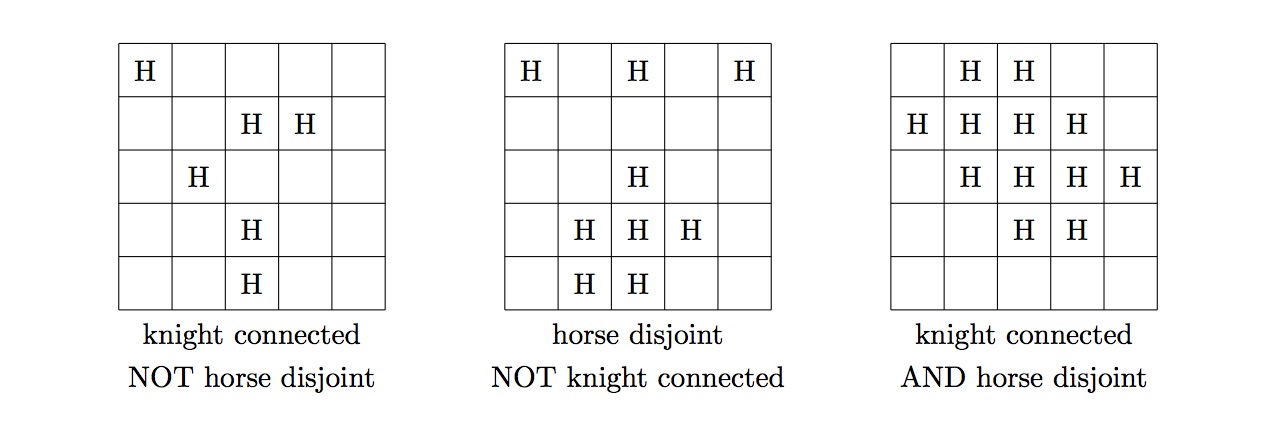
A set of squares on a chessboard is called knight-connected if a knight can travel between any two squares in the set using only legal moves without using any squares not in the set.
A set of squares on a chessboard is called horse-disjoint if, when a horse is placed on every square in the set (and no other square), no horse can attack any other.
 Let
Let
Find
Write-up coming later
The complete problem is available here. An approach, code, and answer will be added later.