PUZZLE IBM-283
Sliding maze puzzle - part 2
IBM Research · Ponder This · 2021-11
IBM Ponder This #283 · November 2021
We return to the maze from the October 2021 challenge (described again in detail in the appendix below), with some differences: Now columns can be moved up/down and rows left/right, but we can no longer move the row/column where the robotic mouse is situated. One slide moves the row/column exactly one cell.
Before and after performing a slide, the mouse can be moved to any cell reachable from its current location; it can also stay in its current place.
To denote slides we now use the following format: "U", "D", "L", "R" represent "Up", "Down", "Left", and "Right", so "U3" means "slide column number 3 one cell up" and "L6" means "slide row number 6 one cell left".
An example of the format for the move list:
[(3,5), "D2", "L4", (6,3), "R0", (7,7)]
Meaning* Move the mouse from
- Slide column 2 down.
- Slide row 4 left.
- Move the mouse from
- Slide row 0 right.
- Move the mouse from
This set of move consists of 3 slides.
Note that
[(3,5), "D2", "L3"]
is illegal, since the mouse is in row 3 when the "L3" command is reached.
Your goal: Given the 15x15 maze
593eaacd395ac6eac5a556aa53e3d539bac799c65a5a33da69663a3a33c635a635c3535c95696aa67b3cd3c576993576559db7aaa3655ac5753a933b593eabeca599965ac5a363a3c3d6acaa37cce3c9ecc3cb6397b99b66aa6e37ac9c55caa3c5937d5a3aa5ca3a9a5bcac3bd5a96c3b
Find a sequence of moves for the mouse and row/column slides such that the mouse reaches the exit in at most 50 slides.
A bonus "*" will be given for solving the 10x10 maze
63aaac95c57baca9eadcc6c575ed9a5c57eaa96395975533c65c66a95c979566abae9ac5bbc7b7a6ec9e3eab563659c5737a
In at most 20 moves *without moving the mouse* except in the last move.
Appendix - description of the maze and the problem:
We are guiding a robotic mouse in a two dimensional maze. The mouse is situated in the upper-left corner of the maze, and must reach the lower-right corner. Unfortunately, there is no direct path in the maze between those two corners. However, we can slide the rows and columns of the maze: by sliding a row we move all the cells in the row one cell-length to the right, re-inserting the rightmost cell from the left. By sliding a column we do the same, sliding cells down and re-inserting the bottom cell from the top. We can also slide rows left and columns up.
We represent a maze by a hexadecimal string in the following manner: First, each cell in the maze is represented by a 4-digit binary string representing which passages are blocked (0) and which are open (1) for the directions "up", "right", "down" and "left". Every such 4-digit string can be converted to a single hexadecimal digit; this correspondence can be seen in the following illustration:
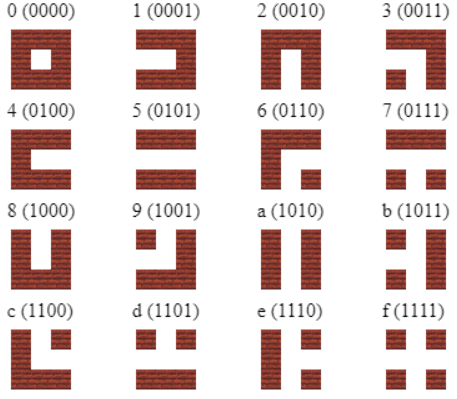
An
9182df2ec797b9c88df0af877be505daa6f6575a3cf4c5623
represents the following maze:
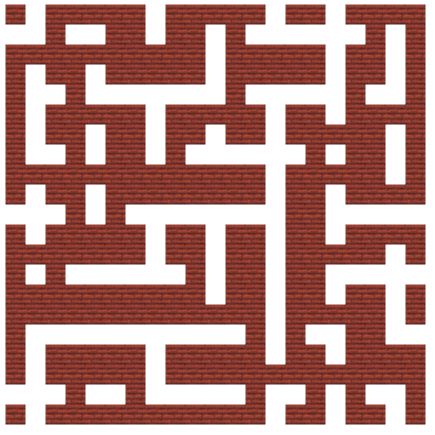
We denote cells in the maze by
Solution
Best opened after a real attemptTo be added.