PROJECT EULER · #0155
Counting Capacitor Circuits
An electric circuit uses exclusively identical capacitors of the same value
The capacitors can be connected in series or in parallel to form sub-units, which can then be connected in series or in parallel with other capacitors or other sub-units to form larger sub-units, and so on up to a final circuit.
Using this simple procedure and up to
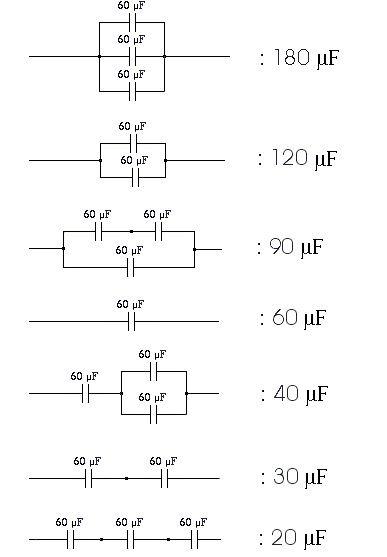
If we denote by
Find
Reminder: When connecting capacitors
whereas when connecting them in series, the overall capacitance is given by:
Write-up coming later
The complete problem is available here. An approach, code, and answer will be added later.