PROJECT EULER · #0256
Tatami-Free Rooms
Tatami are rectangular mats, used to completely cover the floor of a room, without overlap.
Assuming that the only type of available tatami has dimensions
For this problem, we consider only rectangular rooms with integer dimensions
We use the term 'size' to denote the floor surface area of the room, and — without loss of generality — we add the condition
There is one rule to follow when laying out tatami: there must be no points where corners of four different mats meet.
For example, consider the two arrangements below for a
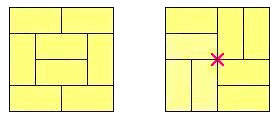
The arrangement on the left is acceptable, whereas the one on the right is not: a red "X" in the middle, marks the point where four tatami meet.
Because of this rule, certain even-sized rooms cannot be covered with tatami: we call them tatami-free rooms.
Further, we define
The smallest tatami-free room has size
All the other rooms of size
Hence,
Similarly, we can verify that
In fact,
Find the smallest room-size
Write-up coming later
The complete problem is available here. An approach, code, and answer will be added later.