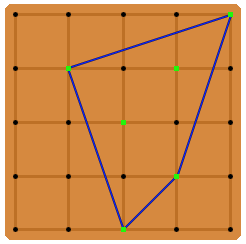
A geoboard (of order ) is a square board with equally-spaced pins protruding from the surface, representing an integer point lattice for coordinates .
John begins with a pinless geoboard. Each position on the board is a hole that can be filled with a pin. John decides to generate a random integer between and (inclusive) for each hole in the geoboard. If the random integer is equal to for a given hole, then a pin is placed in that hole.
After John is finished generating numbers for all holes and placing any/all corresponding pins, he wraps a tight rubberband around the entire group of pins protruding from the board. Let represent the shape that is formed. can also be defined as the smallest convex shape that contains all the pins.
The above image depicts a sample layout for . The green markers indicate positions where pins have been placed, and the blue lines collectively represent the rubberband. For this particular arrangement, has an area of . If there are fewer than three pins on the board (or if all pins are collinear), can be assumed to have zero area.
Let be the expected area of given a geoboard of order . For example, , , and when rounded to five decimal places each.
Calculate rounded to five decimal places.
Write-up coming later
The complete problem is available here. An approach, code, and answer will be added later.