Assuming that two points are chosen randomly (with uniform distribution) within a rectangle, it is possible to determine the expected value of the distance between these two points.
For example, the expected distance between two random points in a unit square is about , while the expected distance between two random points in a rectangle with side lengths and is about .
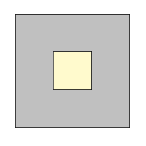
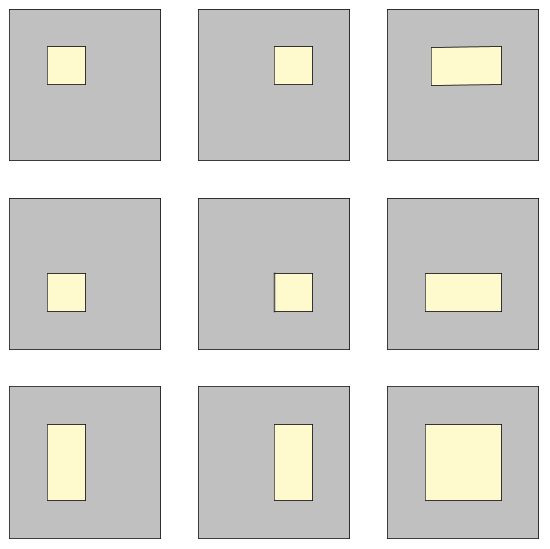
Now we define a hollow square lamina of size to be an integer sized square with side length consisting of unit squares from which a rectangle consisting of unit squares () within the original square has been removed.
For there exists only one hollow square lamina:
For you can find distinct hollow square laminae, allowing shapes to reappear in rotated or mirrored form:
Let be the sum of the expected distance between two points chosen randomly within each of the possible hollow square laminae of size . The two points have to lie within the area left after removing the inner rectangle, i.e. the gray-colored areas in the illustrations above.
For example, and , rounded to four digits after the decimal point.
Find rounded to four digits after the decimal point.
Write-up coming later
The complete problem is available here. An approach, code, and answer will be added later.