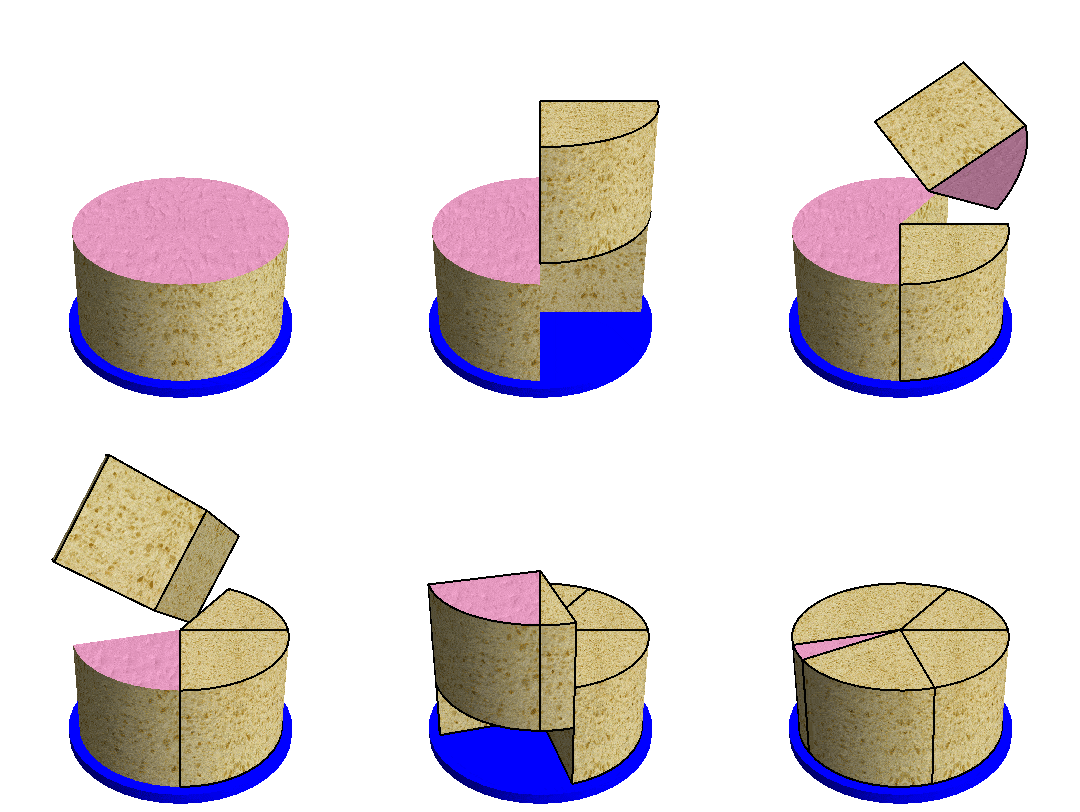
Adam plays the following game with his birthday cake.
He cuts a piece forming a circular sector of degrees and flips the piece upside down, with the icing on the bottom.
He then rotates the cake by degrees counterclockwise, cuts an adjacent degree piece and flips it upside down.
He keeps repeating this, until after a total of twelve steps, all the icing is back on top.
Amazingly, this works for any piece size, even if the cutting angle is an irrational number: all the icing will be back on top after a finite number of steps.
Now, Adam tries something different: he alternates cutting pieces of size degrees, degrees and degrees. The first piece he cuts has size and he flips it. The second has size and he flips it. The third has size and he flips it. He repeats this with pieces of size , and in that order until all the icing is back on top, and discovers he needs flips altogether.
Let be the minimum number of piece flips needed to get all the icing back on top for pieces of size degrees, degrees and degrees.
Let , for integers , and .
You are given that , , .
You are also given , and .
Find .
Write-up coming later
The complete problem is available here. An approach, code, and answer will be added later.