PROJECT EULER · #0781
Feynman Diagrams
Let
- two vertices of degree
For example,
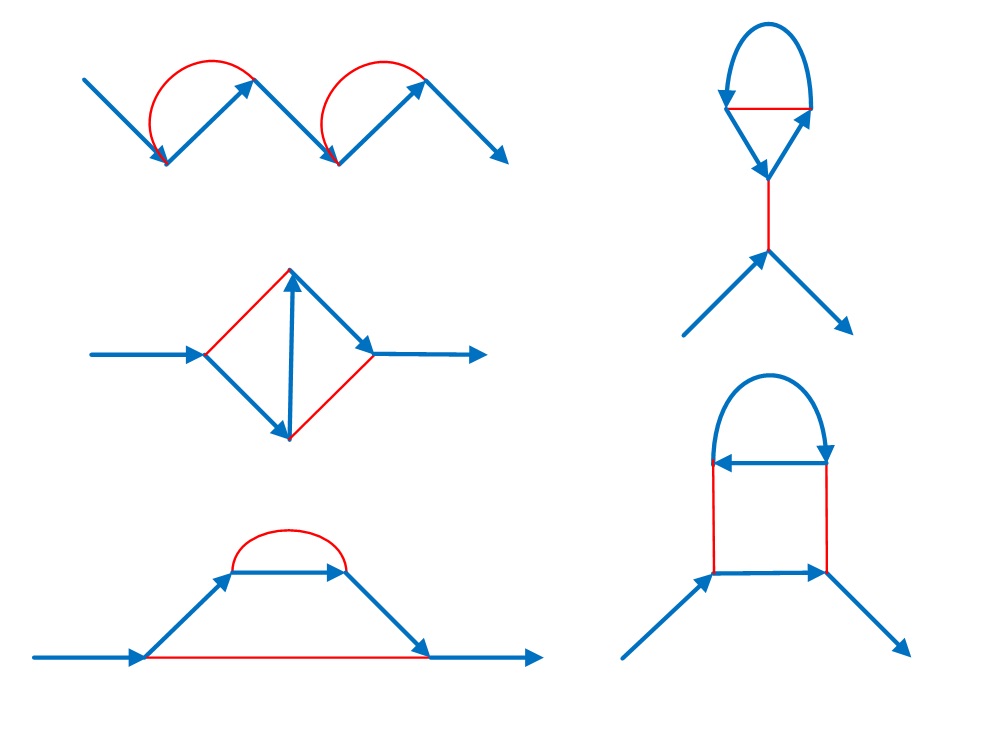
You are also given
Find
NOTE: Feynman diagrams are a way of visualising the forces between elementary particles. Vertices represent interactions. The blue edges in our diagrams represent matter particles (e.g. electrons or positrons) with the arrow representing the flow of charge. The red edges (normally wavy lines) represent the force particles (e.g. photons). Feynman diagrams are used to predict the strength of particle interactions.
Write-up coming later
The complete problem is available here. An approach, code, and answer will be added later.