PROJECT EULER · #0837
Amidakuji
Amidakuji (Japanese: 阿弥陀籤) is a method for producing a random permutation of a set of objects.
In the beginning, a number of parallel vertical lines are drawn, one for each object. Then a specified number of horizontal rungs are added, each lower than any previous rungs. Each rung is drawn as a line segment spanning a randomly select pair of adjacent vertical lines.
For example, the following diagram depicts an Amidakuji with three objects (
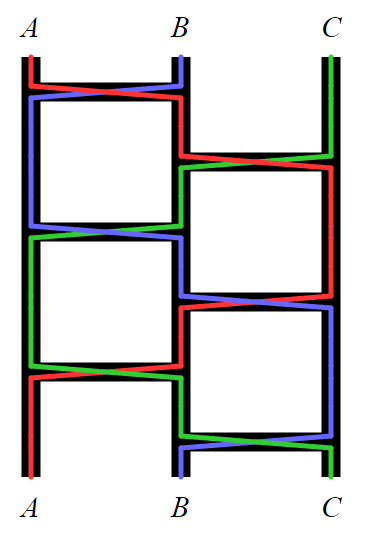
The coloured lines in the diagram illustrate how to form the permutation. For each object, starting from the top of its vertical line, trace downwards but follow any rung encountered along the way, and record which vertical we end up on. In this example, the resulting permutation happens to be the identity:
Let
You are also given that
Find
Write-up coming later
The complete problem is available here. An approach, code, and answer will be added later.