← Complete problem index

PROJECT EULER · #0090

Cube Digit Pairs

Statement only · SolvedOriginal problem ↗

Each of the six faces on a cube has a different digit (0 to 9) written on it; the same is done to a second cube. By placing the two cubes side-by-side in different positions we can form a variety of 2-digit numbers.

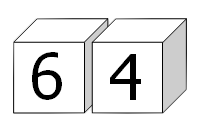
For example, the square number 64 could be formed:


In fact, by carefully choosing the digits on both cubes it is possible to display all of the square numbers below one-hundred: 01, 04, 09, 16, 25, 36, 49, 64, and 81.

For example, one way this can be achieved is by placing {0,5,6,7,8,9} on one cube and {1,2,3,4,8,9} on the other cube.

However, for this problem we shall allow the 6 or 9 to be turned upside-down so that an arrangement like {0,5,6,7,8,9} and {1,2,3,4,6,7} allows for all nine square numbers to be displayed; otherwise it would be impossible to obtain 09.

In determining a distinct arrangement we are interested in the digits on each cube, not the order.

  • {1,2,3,4,5,6} is equivalent to {3,6,4,1,2,5}
  • {1,2,3,4,5,6} is distinct from {1,2,3,4,5,9}

But because we are allowing 6 and 9 to be reversed, the two distinct sets in the last example both represent the extended set {1,2,3,4,5,6,9} for the purpose of forming 2-digit numbers.

How many distinct arrangements of the two cubes allow for all of the square numbers to be displayed?

Write-up coming later

The complete problem is available here. An approach, code, and answer will be added later.