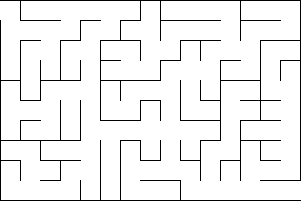
We deal with mazes which are composed of an grid of rectangular cells, where each cell is connected to its four direct neighbors. For each pair of neighbors, either there is a wall between them or not. The maze is constructed in such a manner such that for every two cells in the maze, there is excactly one path between them - in particular, one path from the beginning to the end.
Under these constraints, it can be seen there are exactly 192 mazes of size (we count mazes as distinct even if they are the same up to rotation/reflection). The number of mazes grow exponentially with length; for a size of as in the picture, the number of mazes is already , which can be stylized as "1.289e66"
Your goal: Find the number of mazes. Give your result styled as above, in the form of a floating-point number with four digits of precision followed by an exact exponent.
A Bonus "*" will be given for finding the number of mazes. Give your result in the same format as above.