ROSECODE 377
Exploring the Hilbert Curve
The Hilbert curve is a space-filling curve described by the great German mathematician David Hilbert in 1891.
It is defined as the limit of the following process:
We start with a square of side 1 that we divide in 4 parts.
We join the center of each sub-square as shown in the picture.
We repeat the process by dividing the square in 16 parts.
The Hilbert curve is the curve obtained when continuing this process infinitely.
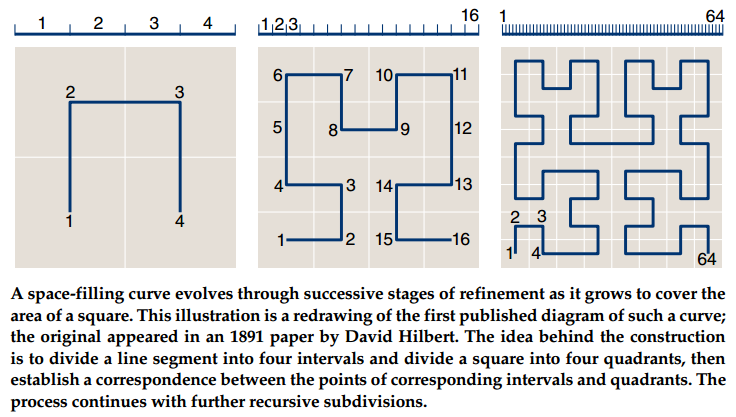
As this curve encounters every point in the square, we can establish a bijection between the square and the segment [0,1], as shown in the picture.
What is the point
What point
(
Answer format:
Hint:
You are given the point in the square corresponding to
[My timing: < 1 sec]
Credit to Brian Hayes for the pictures
It is defined as the limit of the following process:
We start with a square of side 1 that we divide in 4 parts.
We join the center of each sub-square as shown in the picture.
We repeat the process by dividing the square in 16 parts.
The Hilbert curve is the curve obtained when continuing this process infinitely.
As this curve encounters every point in the square, we can establish a bijection between the square and the segment [0,1], as shown in the picture.
What is the point
What point
(
Answer format:
Hint:
You are given the point in the square corresponding to
[My timing: < 1 sec]
Credit to Brian Hayes for the pictures