ROSECODE 414
Convex numbers
Take the number 134431001 as an example. We can make pairs using the 2 digits following one another:
[(1, 3), (3, 4), (4, 4), (4, 3), (3, 1), (1, 0), (0, 0), (0, 1)]
If we assume that these are the lattice points, we can draw line segments in the same order and we can have a polygon.
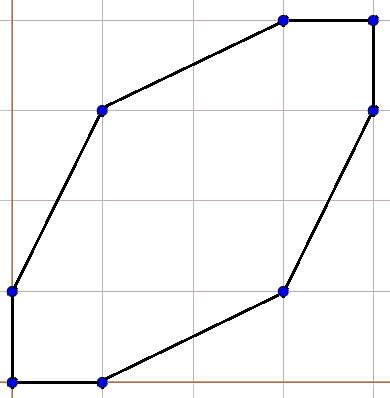 In general for a k-digit number like d1d2...dk we can have a (k-1)-gon:
[(d1,d2), (d2,d3), ..., (dk-1,dk)]
If the drawn polygon is a convex one then we will call this kind of number as convex number.
How many positive convex numbers are there?
Answer format: count,sum
[My timing: < 1m]
Notes:
- Any two neighbouring line segments cannot be collinear.
- All the generated pairs must be distinct.
- Some polygons can be generated by more than one number.
For example: 112321, 123211, 232112, 321123, 211232
Since the numbers are different, they are all counted.
In general for a k-digit number like d1d2...dk we can have a (k-1)-gon:
[(d1,d2), (d2,d3), ..., (dk-1,dk)]
If the drawn polygon is a convex one then we will call this kind of number as convex number.
How many positive convex numbers are there?
Answer format: count,sum
[My timing: < 1m]
Notes:
- Any two neighbouring line segments cannot be collinear.
- All the generated pairs must be distinct.
- Some polygons can be generated by more than one number.
For example: 112321, 123211, 232112, 321123, 211232
Since the numbers are different, they are all counted.
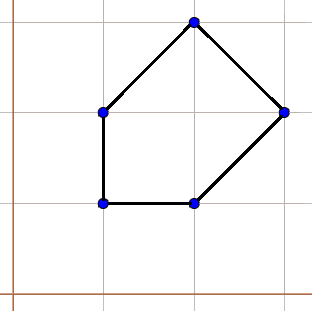
In general for a k-digit number like d1d2...dk we can have a (k-1)-gon:
[(d1,d2), (d2,d3), ..., (dk-1,dk)]
If the drawn polygon is a convex one then we will call this kind of number as convex number.
How many positive convex numbers are there?
Answer format: count,sum
[My timing: < 1m]
Notes:
- Any two neighbouring line segments cannot be collinear.
- All the generated pairs must be distinct.
- Some polygons can be generated by more than one number.
For example: 112321, 123211, 232112, 321123, 211232
Since the numbers are different, they are all counted.