ROSECODE 457
Integral circle packings 1
Three circles
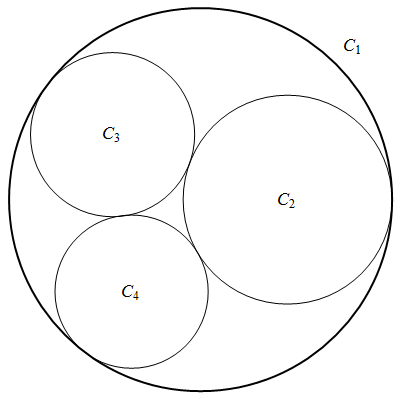
We can repeatedly fill the interstices between mutually tangent circles with further tangent circles and generate a circle packing. Denote the curvature of a circle be the reciprocal of its radius. Interestingly, every circle in such a packing would have integer curvature if the curvatures of four mutually tangent circles
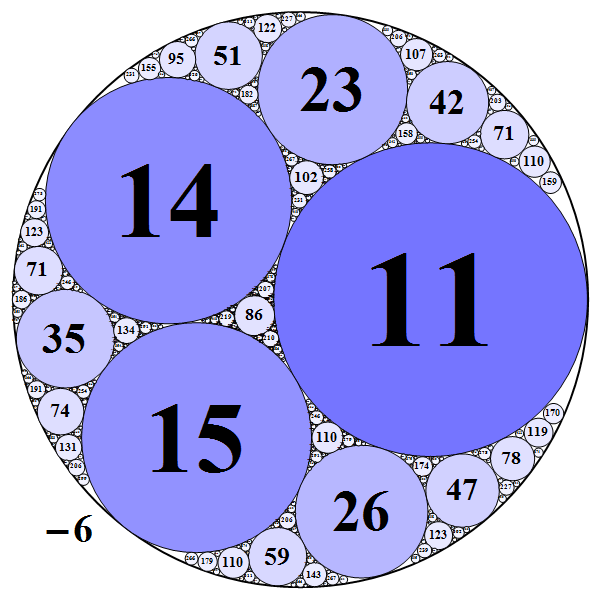
The figure below shows an integral circle packing with curvatures of four circles -6, 11, 14 and 15 (each circle is labeled with its curvature and only part of circles are shown).
Define an integer quadruple (
If greatest common divisor of
All curvatures (negative signs are omitted) of an integral circle packing form an infinite integer set. Especially there are infinite primes in the set if the quadruple for packing is primitive. For example, for primitive quadruple (-3, 4, 12, 13), the primes in the set are 3, 13, 37, 61, 109, 157, 181, 229 and so on. Let
You are given
Find
We can repeatedly fill the interstices between mutually tangent circles with further tangent circles and generate a circle packing. Denote the curvature of a circle be the reciprocal of its radius. Interestingly, every circle in such a packing would have integer curvature if the curvatures of four mutually tangent circles
The figure below shows an integral circle packing with curvatures of four circles -6, 11, 14 and 15 (each circle is labeled with its curvature and only part of circles are shown).
Define an integer quadruple (
If greatest common divisor of
All curvatures (negative signs are omitted) of an integral circle packing form an infinite integer set. Especially there are infinite primes in the set if the quadruple for packing is primitive. For example, for primitive quadruple (-3, 4, 12, 13), the primes in the set are 3, 13, 37, 61, 109, 157, 181, 229 and so on. Let
You are given
Find