← RoseCode

ROSECODE 460

Polygonal billiards

liuguangxi · Math ·

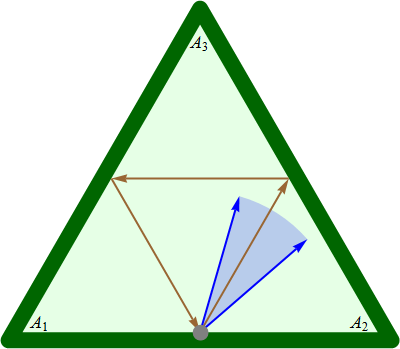
Given a regular n-sided polygon (n3) billiard table and its vertices are labeled A1, A2,, An in anticlockwise direction. A billiard ball is placed in the middle of the edge A1A2. When it is launched at a certain angle, it keeps moving and reflects off the sides of the table. Suppose the table and the ball are ideal, and reflection and incidence angles are the same when bouncing off the edge.

Let’s take an equilateral triangle table (n = 3) as an example.


When the ball is launched at angle 60 degrees, it hits the edge A2A3 and A3A1, and just returns to start point. For the n-sided polygon, there exists a continuous launch angle range such that the ball hits edge A2A3, A3A4,, An1An in turn and return to edge A1A2 at last. For the equilateral triangle table, the minimum launch angle is 40.893394649131 degrees, and the maximum one is 73.897886248014 degrees. See blue arrows in above figure.

Let D(n) be the length of launch angle range satisfying above rule for a regular n-sided polygon, in degrees. You are given D(3)=33.004491598883, D(10)=1.866152295275 and D(50)=0.072102098755.

Find n=32018D(n). Give your answer rounded to 10 digits after the decimal point.